Up: presentation-increasing-response-rates-incentives
Response Effects of Prenotification, Prepaid Cash, Prepaid Vouchers, and Postpaid Vouchers: An Experimental Comparison.
Reading: Veen, Floris Van, Anja S. Göritz, and Sebastian Sattler. 2016. “Response Effects of Prenotification, Prepaid Cash, Prepaid Vouchers, and Postpaid Vouchers: An Experimental Comparison.” Social Science Computer Review 34(3): 333–46. doi:10.1177/0894439315585074.
KEYWORDS: incentives, response rate, retention rate, item nonresponse, web survey, prenotification, experiment
General
- This study checks how sending a heads-up letter (prenotification) and different types of rewards affect whether university students start, finish, and fully answer an online survey.
- The survey, done in 2011 with 1,750 German students, asked about study conditions and cheating.
What they did
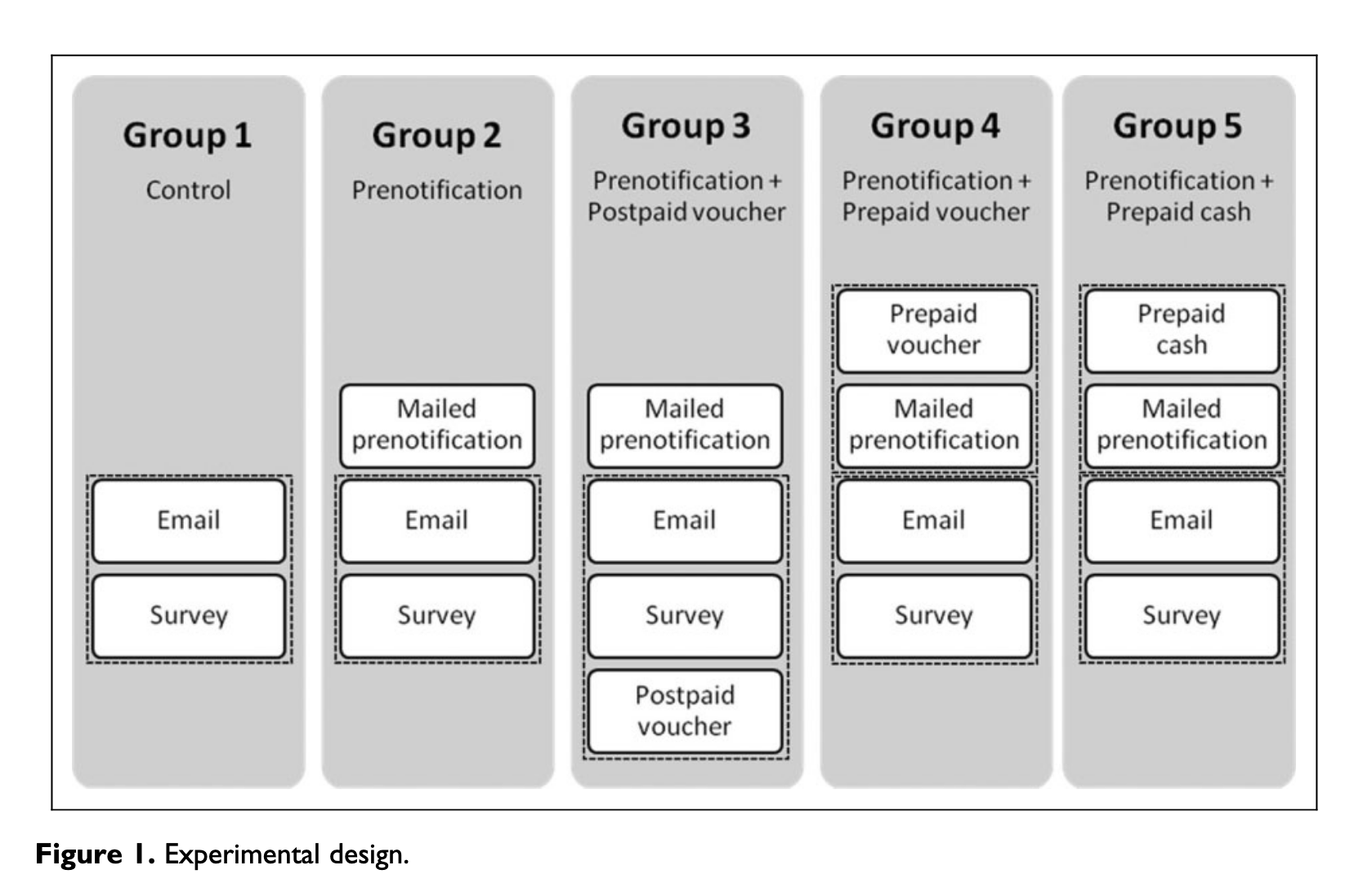
- Survey Setup: 1,750 students were split into five groups:
- Group 1 (Control): Got an email invite to the survey, no letter or reward.
- Group 2: Got a letter a week before the email invite, no reward.
- Group 3: Got a letter promising a €5 voucher after finishing the survey (postpaid voucher).
- Group 4: Got a letter with a €5 voucher included (prepaid voucher).
- Group 5: Got a letter with a €5 bill included (prepaid cash).
- Why €5?: It’s the smallest euro bill (coins are hard to mail) and fair for a 30-minute survey, based on typical student job pay.
- What they measured?
- Response: Percent of people who started the survey (submitted the first page)
- Retention: Percent of starters who finished the last page.
- Item Nonresponse: Average number of question skipped by those who finished.
- Costs: Money spent on letters, rewards, and other expenses, plus cost per person who started or finished.
- How it worked: The letter told students a survey was coming, included university logos to seem legit, and mentioned rewards (if any). The survey link came by email. Non-responders got two reminder emails.
Findings
- Did the letter help? Yes:
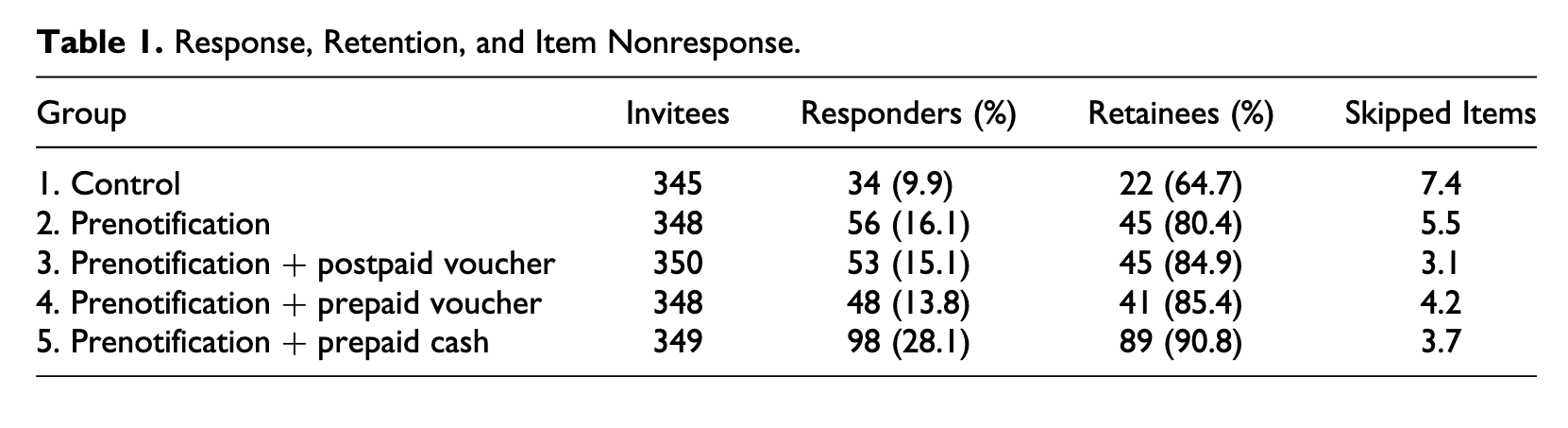
- Group 2 (letter only) had 16.1% start the survey vs Group 1 (no letter). They were 75% more likely to start.
- More finished (80.4% of starters vs 64.7%) and skipped fewer questions (5.5 vs 7.4 on average).
- Did rewards help? It depends:
- Group 5 (prepaid cash) was best: 28.1% started and finished, skipping 3.7 questions on average. They were twice as likely to start and finis compared to Group 2 (letter only).
- Group 3 (postpaid voucher): 15.1% started, 84.9% of them finished, and they skipped the fewest questions (3.1). But starting was no better than Group 2.
- Group 4 (prepaid voucher): 13.8% started, 85.4% finished, skipping 4.2 questions. No big difference from Group 2 for starting or finishing, but fewer skipped questions.
- Vouchers vs. Cash: Cash got more people to start (28.1% vs. 13.8% for prepaid voucher), but finishing and skipping questions were similar. Postpaid vouchers led to fewer skipped questions than prepaid vouchers.
- Why this happened?
- Letters make the survey seem important and legit, encouraging people to start and finish.
- Cash upfront feels like a gift, making people feel they should do the survey to “pay back” the favor.
- Vouchers are less appealing because they’re only useful at one store, take effort to use, and might not feel like a real gift (especially postpaid ones).
- Postpaid vouchers might make people answer more questions to ensure they get the reward.
- Costs:
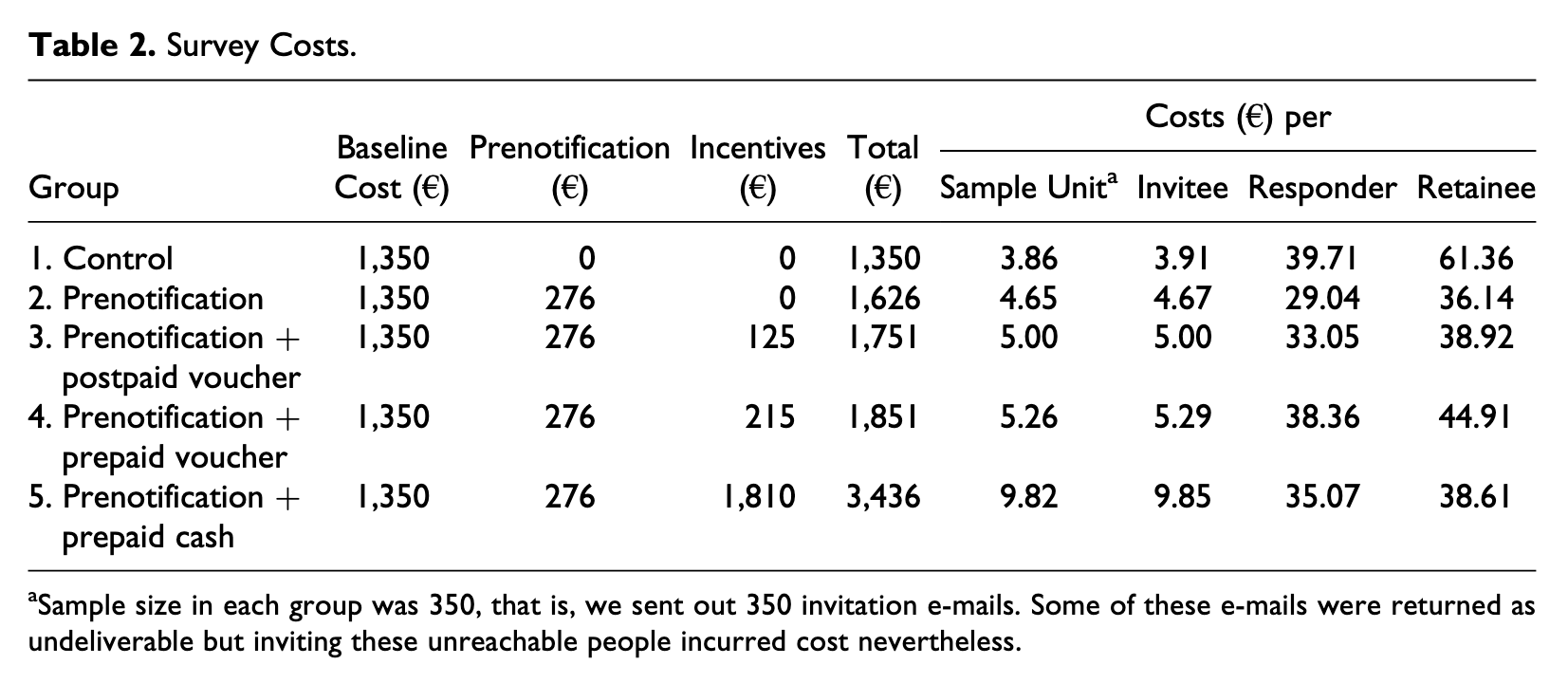
- Total Cost: Highest for Group 5 (3,436, due to €5 for each) and lowest for Group 1 (€1,350, no letters or rewards).
- Cost per Person: Cheapest per starter and finisher in Group 2 (€29.04 per starter, €36.14 per finisher) and highest in Group 1 (€39.71 per starter, €61.36 per finisher). Cash was expensive but got more responses, balancing costs.
What it means
- Main Points:
- Sending a letter before the survey email gets more people to start, finish, and answer questions fully.
- Giving €5 cash with the letter works best for getting people to start and finish.
- Vouchers don’t help much with starting or finishing but reduce skipped questions, especially postpaid ones.
- Letters alone are a cheap way to improve surveys; cash works great but costs more.
- The research didn’t test postpaid cash or other rewards like gift cards.
Baseline Cost Nedir?
- Baseline cost (€1,350), tüm gruplar için ortak olan sabit giderleri kapsıyor. Bunlar:
- Anketi programlama maliyeti (web sitesini hazırlayanların emeği).
- Davet e-postalarını yazma ve gönderme giderleri.
- Anket sunucularının çalışması için gereken teknik altyapı (örneğin, server maliyeti).
- Proje yönetimi veya diğer idari işler (örneğin, veri toplama sürecini denetleme).
- Bu maliyetler, üniversitenin anketi yürütmek için harcadığı genel giderler. Group 1’de başka bir şey (mektup veya ödül) eklenmediği için total maliyet sadece bu €1,1’tan ibaret.