Up: democratization-autocratization Prev: week1-introduction-democratization Next: week3-response-rates-and-nonresponse-bias

Waves of Democratization
Reading Notes:
Huntington (1991)
- The Start of the 3rd Wave: April 25, 1974, Portugal — Coup / Carnation Revolution against Antonio Salazar
- Political chaos for 18 months — different fractions within the military junta
- Marxists, conservative, liberal
- Liberals won at the end, Marxist fractions were defused
- Political chaos for 18 months — different fractions within the military junta
- Between 1974-1990, approximately around 30 countries switched to democracy, some others were liberalized:
- Southern Europe: Portugal, Greece, Spain
- Latin America: Brazil, Argentina, Uruguay
- Asia: Philippines, South Korea, Taiwan
- Soviet Block: Poland, Czechia, Eastern Germany
- Freedom House population percentage living under democracy:
- 1973 — %32
- 1990 — %39
- 1990 → %45,4 of world countries are democratic, same as the peak of 1st Wave in 1922
- Defitinion of Democracy: Huntington describes it procedural
- “The central procedure of democracy is the selection of leaders through competitive elections by the people they govern.”
- Most powerful collective decision makers are selected through fair, honest, and periodic elections in which candidates freely compete for votes and in which virtually all the adult population is eligible to vote.
- Dimension of contestation
- Dimension of participation
- Liberalization and Democratization are not the same.
- Liberalization may or may not lead to full-scale democratization.
- The definition of democracy in terms of elections is a minimal definiton.
- open, free and fair, are the essence of democracy
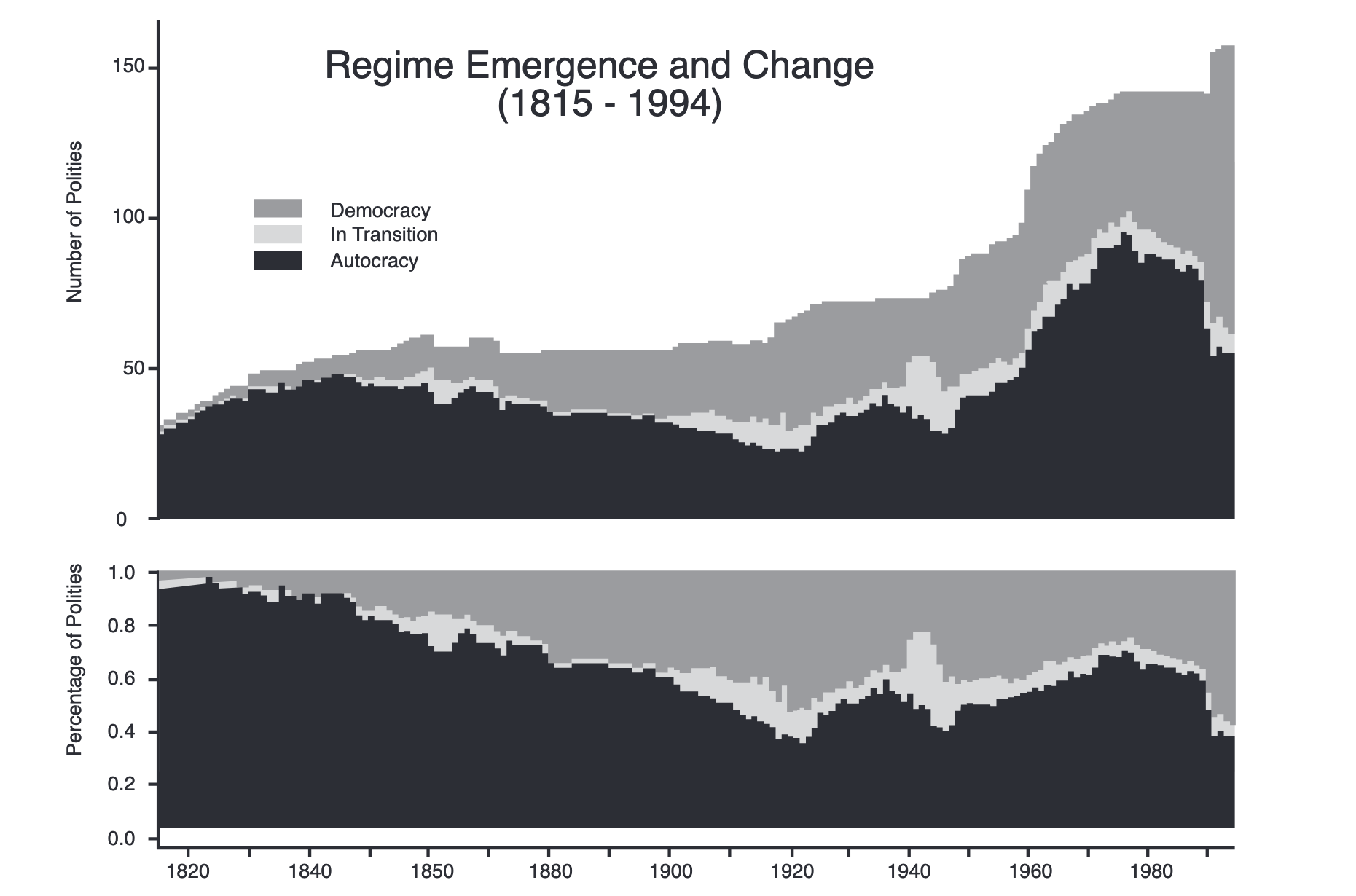
- 3 Waves throughout history:
- 1828-1926: Rooted on French and American Revolutions — around 30 countries are democratized
- 1943-1962: After WW2 — West Germany, Japan, Turkey, newly established states like India
- 1974-: Starting with Portugal, South Europe, Latin America, Asia and Eastern Europe
- Reverse Waves:
- 1922-1942: Mussolini in Italy, Hitler in Germany, also communist/socialist states
- 1958-1975: Brasil, Chile, Philiphines, India, Nigeria
- Reverse waves show the vulnerability of the democracies, especially in the newly established ones
Goldring and Greitens (2020)
- Main Argument: The article challenges the conventional emphasis on geographic proximity in studies of democratic diffusion
- regime type similarity is a more significant driver of authoritarian breakdown and democratization.
- SIMILAR STRUCTURAL VULNERABILITIES IS THE KEY
- Democratic diffusion: spread of democratization across borders, often observed in temporal and spatial clusters (the fall of communist regimes in Eastern Europe in 1989)
- Prior studies have focused on geographic proximity: democratization in one country increases the likelihood of democratization in nearby countries
- this focus overlooks the role of regime type
- Authoritarian breakdown and democratization spread along networks of similar regimes (e.g., single-party regimes or monarchies)
- Example: The 1989 transitions in Eastern Europe (e.g., Poland, Hungary) influenced other single-party communist regimes globally
- Prior studies have focused on geographic proximity: democratization in one country increases the likelihood of democratization in nearby countries
- Key Contribution: Democratic diffusion as a regime-type phenomenon
- reducing the explanatory weight of geographic proximity
- highlighting the role of regime similarity.
- Example: Geographically closer but dissimilar regimes poses less probability
- How? — “Transitions in one authoritarian regime make transitions in autocratic regimes of a similar type more likely”
- Regime Type and Vulnerability: A regime’s type determines its vulnerability to popular protests.
- Different regime types have distinct institutional structures, leadership features, and tools for managing opposition, which affect their ability to withstand contention.
- single-party regimes like China and Poland rely on centralized party control, making them vulnerable to organized opposition (e.g., labor unions)
- military regimes (e.g., South Korea in 1987) may rely on coercive force but face internal splits
- personalist regimes (e.g., Philippines under Marcos) depend on loyalty to a single leader, making them vulnerable to elite defection
- Different regime types have distinct institutional structures, leadership features, and tools for managing opposition, which affect their ability to withstand contention.
- Regime Isomorphism: Similarity in regime type (regime isomorphism) increases the likelihood that protest strategies effective against one regime will work against another of the same type. Protesters often use cognitive shortcuts, copying tactics from other contexts.
- Regime Type and Vulnerability: A regime’s type determines its vulnerability to popular protests.
- Authoritarian Learning: The gradual nature of authoritarian learning reinforces diffusion along regime-similarity lines. Regimes learn from the failures of similar regimes.
- China in 1989 is their Case Study
- China faced potential diffusion from two sources:
- geographically proximate regimes in East Asia (e.g., South Korea, Philippines)
- distant but similar single-party communist regimes in Eastern Europe (e.g., Poland, Hungary)
- Chinese Communist Party (CCP) leaders were more concerned about regime collapse diffusing from single-party regimes in Eastern Europe than from geographically closer regimes in East Asia.
- China faced potential diffusion from two sources:
- Arab Spring (2011):
- Tunisia → Middle East → North Africa
- only Tunisia democratized.
- similar presidential republics (e.g., Egypt) experienced breakdowns because their institutional weaknesses (e.g., reliance on fragmented security forces) mirrored Tunisia’s
- monarchies, with different tools, resisted these pressures
- Tunisia → Middle East → North Africa
- Implications for Future Research
- Regime similarity may not be the only pathway for diffusion.
- Linguistic groups and religious networks could also facilitate diffusion through shared frameworks and transnational contacts
- Regime similarity may not be the only pathway for diffusion.
Questions:
- To Huntington, what are the key factors contributing to the emergence of democratization waves? What causality does he attribute to the three waves?
- *First Wave (1828–1926)
- Economic and social development: Industrialization, the growth of the middle class, and urbanization increased demand for democratic institutions.
- Liberal ideas: Enlightenment principles and concepts of individual liberty provided an ideological foundation
- Nation-state formation: Stronger central governments enabled the application of democratic institutions at a national level
- Second Wave (1943–1962)
- Allied occupation: Imposition of democratic institutions in West Germany, Japan, and Italy by Allied forces
- Decolonization: India
- Cold War dynamics: Democracy as an alternative to communism.
- Third Wave (1974–)
- Authoritarian regime failures: Economic crises and backlash against political repression.
- International influence: Global democratic norms, exemplified by Portugal’s Carnation Revolution, inspired transitions.
- Popular mobilization: Grassroots movements, such as Solidarity in Poland, pushed for democratic change.
- *First Wave (1828–1926)
- Answer the same question for the reverse waves of democratization?
- What are the factors for consolidating democracy after a transition? Can we list them?
- Similar to what Goldring & Greitens mention, what factors, other than regime similarity, might cause democratization waves? Can we list them?
- Does the autocratization of globalization and central countries in international relations (e.g., the U.S.) create opportunities for other countries to autocratize in the global conjuncture? Or could the opposite be true?
Lecture Notes:
| Democracy | Autocracy | ||
|---|---|---|---|
- Defining democracy
- Minimalist definition:
- “free competition for a free vote” (Schumpeter, 1942)
- only the ballot box on election day matters
- Standart definition:
- Two dimensions: Competition and participation with eight institutional guarantees (Dahl, 1971)
- Freedom of association
- Freedom of expression
- Right to vote
- Eligibility for public office
- Right of leaders to compete for public support
- Alternative sources of information
- Free and fair elections
- Institutions for making government policies depend on votes
- Two dimensions: Competition and participation with eight institutional guarantees (Dahl, 1971)
- Substantive definitions:
- Will of the people
- Socioeconomic equality
- Other aims…
- Minimalist definition:
- Problems wit substantive definitions
- How to define the will of the people?
Measuring democracy and autocracy (V-Dem)
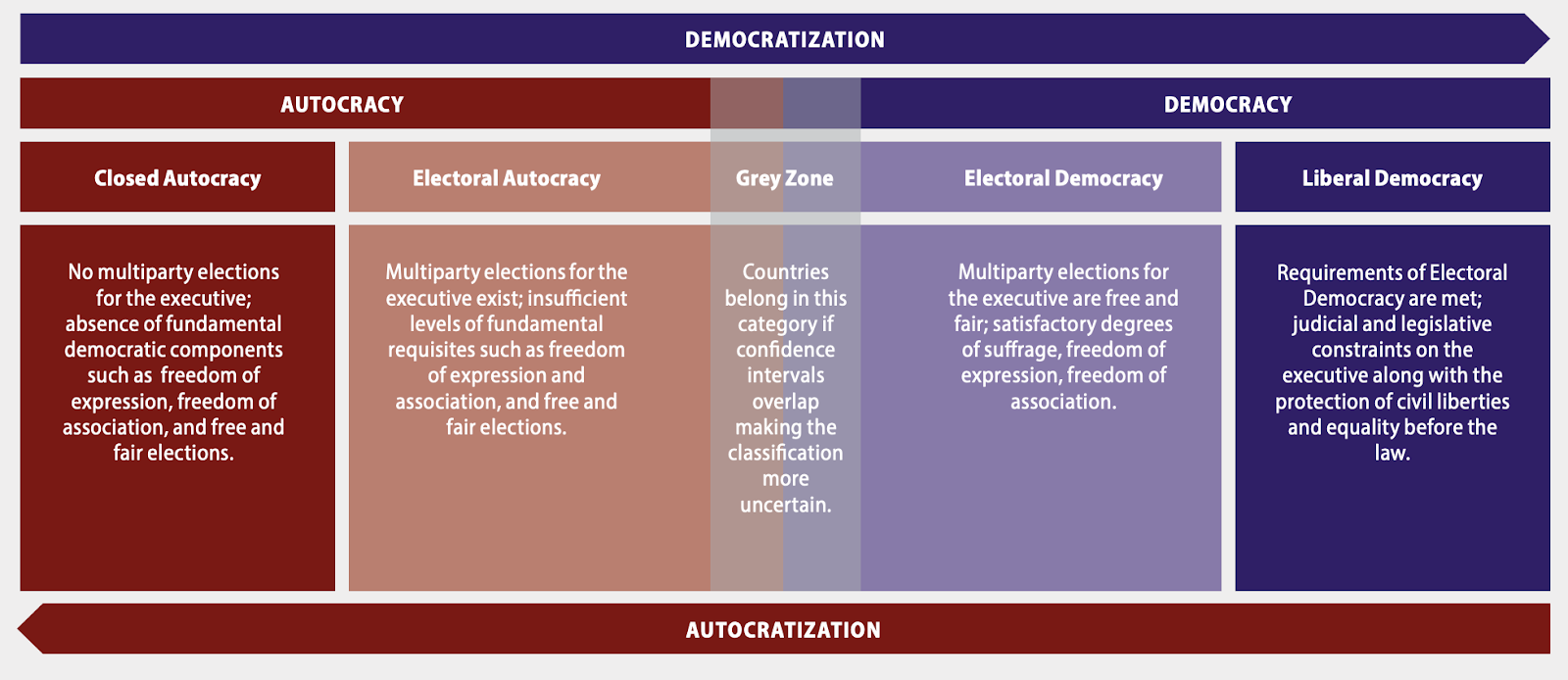
- We are talking about institutional situation of the countries while classifying them
- Accountability of the rulers — to whom?
- Electoral / liberal democracy → Voters
- Military regime → Military council / leader
- One-party regime → Dominant party (China)
- Monarchial regime → Ruling family (Saudi Arabia)
- Personalist regime → The leader (Qaddafi or Kim Jong-Un)
Waves of Democratization
- Definition: A group of transitions from nondemocratic to democratic regimes that occur within a specified …
-
Types of Waves
- Contagion
- Horizontal Contagion: Similar causes at the domestic level lead to cascades of mass uprisings (2011 Arab Spring)
- Vertical Contagion: External shocks such as wars (WWII) or the weakening of a hegemon (USSR) make regimes more vulnerable
- Emulation
- Horizontal Emulation: Learning from one country informs learning in another country
- Vertical Emulation: External shocks such as 1905 Russia’s defeat from Japan & decolonization opens opportunities for pro-democracy and liberation movements
- Contagion
Diffusion of Democracy
- Geography matters
- Regime type: similar regimes have similar vulnerabilities